Stone 02 Independent notes
Breton legends and folklore: Ankou, the City of Ys and Brocéliande
Breton legends are a mix of Christian saints' lives, older beliefs and medieval romance. Four figures or places carry most of it: the Ankou, the city of Ys, the korrigans and Brocéliande.
What counts as Breton mythology?
There is no single Breton mythology in the way there is a Norse or Greek one. What exists is a body of folk tales, ballads, saints' legends and local explanations of the landscape, told in Breton and in French and later written down by collectors. The older layer is hard to date, and many stories mix pagan and Christian elements, so careful books speak of Breton folklore or legends rather than of a pantheon.
This answers a frequent question about the gods of Breton mythology: there is no reliable list of Breton gods that comes down from ancient times. Lists you find online often borrow from Welsh, Irish or Gaulish sources, or from video games that use the word Breton for something else.
The Ankou
The Ankou is the figure of death in Breton folklore. He gathers the souls of the dead and is often pictured as a tall, thin man with a wide hat who drives a cart, whose creaking is a warning. A popular belief says that the last person to die in a parish in a given year takes over the role for the following year.
You can see the Ankou in stone: some parish ossuaries in Brittany carry carvings of him. Late nineteenth century folklorists, notably Anatole Le Braz, collected testimonies about death and the Ankou across the Breton countryside, and his work is still widely cited.
The legend of Ys
Ys is a city said to have stood by the sea and been drowned in a flood. In the most familiar version, King Gradlon rules the city from behind a dyke, his daughter Dahut is tied to its fall, and a saint warns of the danger. Versions differ on how the sea gates were opened and on who is to blame, and local tradition often places the lost city in the bay of Douarnenez.
The tale has travelled well beyond Brittany. Édouard Lalo wrote an opera, Le roi d'Ys, in the late nineteenth century, and the legend is often linked, in popular accounts, to Debussy's piano prelude about a sunken cathedral.
Korrigans and the standing stones
Korrigans are small, mischievous beings of Breton folklore, linked to springs, heaths and megaliths. Folk explanations of dolmens and standing stones often involve them, or a saint who turned pagans or soldiers to stone. The best known case is Carnac, where a local legend says the rows are Roman soldiers changed to stone by a saint. The Carnac stones guide separates the legend from what is known about who really raised them.
Brocéliande and the Arthurian tradition
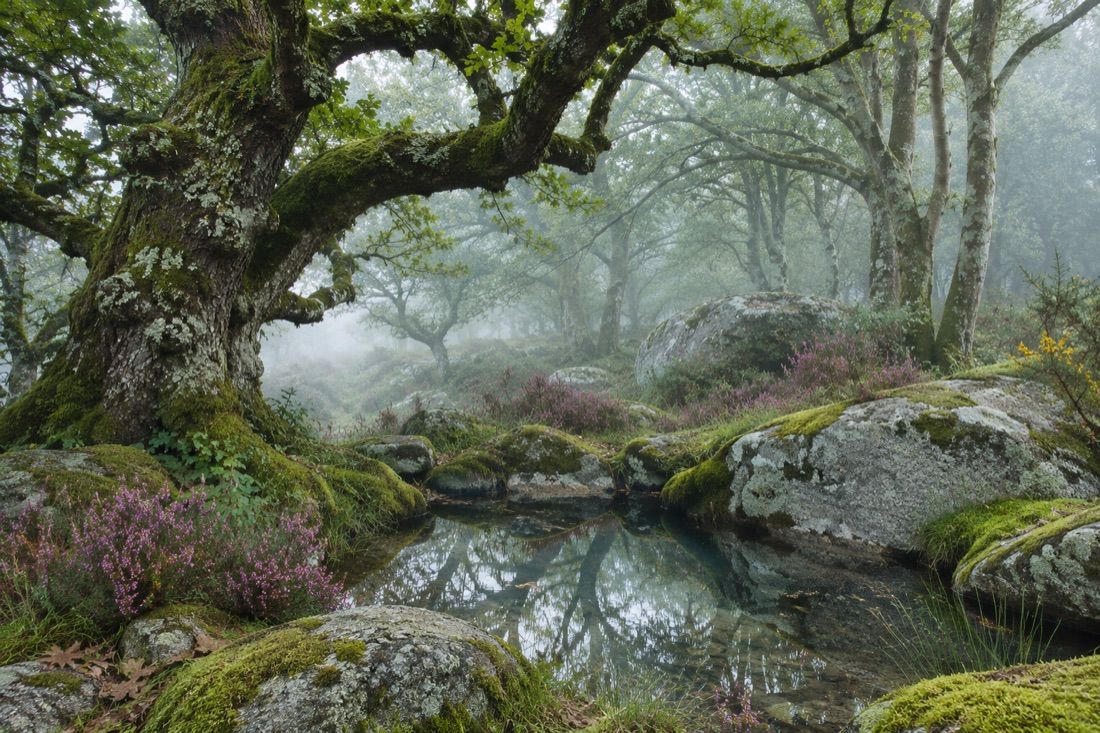
Brocéliande is a forest known from medieval French romance, where Merlin and the fairy Viviane, the spring of Barenton and a valley of no return belong to the Arthurian stories. Is Brocéliande a real place? The name is literary and medieval. Local tradition has long placed it in the forest of Paimpont in Ille-et-Vilaine, and that tradition is the reason it is a walking destination today, but the medieval texts do not fix a map. See the guide to heritage sites for a visitor's view.
Brittany also appears in the wider Matter of Britain because of the Breton lais, short narrative poems of the twelfth and thirteenth centuries that claim Breton sources.
Where to read the tales
The nineteenth century collectors are the base: Émile Souvestre wrote down tales from Lower Brittany in the 1830s and 1840s, François-Marie Luzel collected stories in Breton, and Paul Sébillot recorded tales in the Gallo-speaking east. Public domain English translations of Breton tales and legends are available from digital libraries and from sites that host older books, and the research guide shows how to find them. Treat any collection as a product of its collector's choices.